
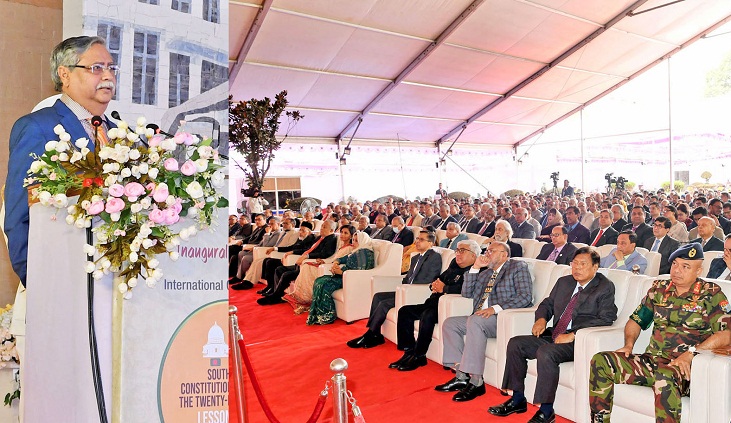
The president has urged to take strict care so that the power is not abused through the judges. Sahabuddin.
He made this call at the opening ceremony of the two-day long conference titled ‘Constitutional Courts of South Asia in the 21st Century: Lessons from Bangladesh and India’ at the Inner Court Yard of Bangladesh Supreme Court on Friday (February 23).
The head of state said, “Power is closely related to responsibility.” Power must be exercised to perform duties. Again, responsibility should be shown in the exercise of power and strict care should be taken to ensure that power is not misused.
Addressing the judges, President Sahabuddin said, “The rule of law and justice must be ensured by being responsible to the country, the people and the constitution.” He hoped that the aspirants would get justice in the shortest possible time at a very low cost and the judges would ensure justice through their talent and thoughtfulness.
Stating that the judiciary must be involved in the progress of overall development and prosperity of the country, the President said, “The government is strongly committed to ensuring the transparency, efficiency and accountability of the judiciary.”
President Sahabuddin mentioned, ‘Bangladesh Supreme Court started its journey on December 18, 1972. Since its inception, it has been working to protect the basic human rights of people, establish the rule of law and provide justice to the litigants in a short period of time.
Md. Sahabuddin said, “The Supreme Court has upheld the fundamental human rights of the people and protected the Constitution whenever necessary during the transition of the nation by fulfilling the duties assigned to it.” In times of peace and crisis, the Supreme Court of Bangladesh is playing a prestigious role as the guardian and protector of the Constitution.
The head of state said, “On August 15, 1975, the anti-independence forces captured the state power by killing the father of the nation Bangabandhu Sheikh Mujibur Rahman, the dreamer of Sonar Bengal, and his family. But the Supreme Court did not allow the blueprint of the conspirators to be implemented. The Bangladesh Supreme Court declared the Fifth and Seventh Amendments of the Constitution illegal and established the democratic rights of the people of the country.
Md. Sahabuddin recalled with deep respect the role of those fearless judges and lawyers of the Supreme Court, who did not bow down to the barrel of a gun and never sold their conscience.
The President said, ‘Bangladesh and India, as two friendly countries in South Asia, have crossed a unique path in their respective journeys in establishing the rule of law, developing democracy and protecting constitutional continuity. Both Bangladesh and India have witnessed instances where the Judiciary has intervened to protect the rights of marginalized communities, uphold the principles of environmental sustainable development and good governance.’
Referring to ‘India as our closest neighbor and friendly country’, President Sahabuddin expressed sincere thanks and gratitude on behalf of the people of Bangladesh for India’s cooperation and sympathy in the Liberation War in 1971. He said, “Since independence, bilateral and diplomatic relations between Bangladesh and India are gradually expanding in various sectors including trade and investment.”
The President also opined that the judicial departments, judges and people of both countries can benefit from the exchange of experience and training programs between the judicial departments, judges and related officials of the two countries. He also asked the constitutional courts of Bangladesh and India to focus on issues such as de-cluttering cases, access to justice and judicial accountability, as well as taking concerted steps for the development of the judiciary.
The President said, “Judges and people of both countries can benefit from the exchange of experience and training programs between judges and related officers of the two countries’ judiciary.” The constitutional courts of Bangladesh and India need to focus on issues such as access to justice and judicial accountability as well as take concerted steps to develop the judiciary.
The Chief Justice of India at this international conference. The President also commented that with the presence of Dhananjay Jaswant Chandrachud, it has gained international multi-dimensionality. He welcomed all the guests including judges of Supreme Court of India and Calcutta High Court who came to the conference.
Mentioning that ‘Bangladesh achieved through the liberation war is now a role model of development in the world’, the head of state urged everyone to work together to build a happy and prosperous Bangladesh by continuing this trend of development.
Chief Justice of Bangladesh Obaidul Hasan, Chief Justice of India. Dhananjay Jaswant Chandrachud, Minister of Law, Justice and Parliamentary Affairs Anisul Haque, Attorney General of Bangladesh Abu Mohammad Amin Uddin, President of the Supreme Court Bar Association. Momtaz Uddin Fakir and Appellate Division Justice Borhan Uddin and others spoke.
Retired Chief Justice, Judges of both Divisions of Bangladesh Supreme Court, Judges of Supreme Court of India and Calcutta High Court, Leaders of Supreme Court Bar Association, Members of Parliament and learned lawyers were present on this occasion.









Design & Devlopment : Ifad Technology


