PROFESSOR DR. MUHAMMAD YUNUS WAS SENTENCED IN HASINA’S TALISMAN COURT
At the beginning of 2024, on January 1, in a court controlled by the Sheikh Hasina government, Professor Dr. Muhammad Yunus has been sentenced to six months in prison for violating the labor law.
JANUARY 7 ONE-SIDED ELECTION
The 12th National Parliament election was held unilaterally without an opposition party on January 7 through the Election Commission under the autocracy of Sheikh Hasina.
Before this, the 10th National Parliament election on January 5, 2014, the 11th National Parliament election on December 30, 2018, and the latest 12th General Election on January 7, 2024 were a betrayal of the country and the nation. The fake election of the 12th National Parliament in 2024 created the backdrop for the fall of Sheikh Hasina. The people of the country became disappointed and angry. People’s unity was formed against the Hasina government.
TEXTBOOK CONTROVERSY
On January 19, at the Institution of Diploma Engineers, Bangladesh in Kakrail in the capital, Asif Mahtab Utsho, a part-time teacher at BRAC University, tore a page from a national curriculum textbook and came into discussion. The issue was widely discussed on social media.
Later, Asif Mahtab was dismissed from BRAC University.
In that seminar, he alleged, “Students are being brainwashed by discussing transgender in the seventh grade history and social science books.” At that time, he tore the page of Sharifa’s story in the chapter ‘Similarities and Differences in People’ of the seventh grade book.
On September 28, the coordination committee formed to revise the textbooks prepared and printed by the National Curriculum and Textbook Board (NCTB) in Bangladesh was dissolved 13 days after its formation.
After this, there was widespread discussion and criticism on social media. However, after the dissolution of the committee, no reason was mentioned or explained by the NCTB or the Ministry of Education.
FIRE ON BAILEY ROAD
The worst fire of this year occurred on February 29. A total of 46 people died in a fire in a multi-storey building called Green Cozy on Bailey Road in Dhaka city. The building housed several restaurants and shops, including Kacchi Bhai Restaurant, Samsung Showroom, Gadget and Gear, Illini, Khana’s and Pizza Inn. As there were restaurants on every floor of the entire building, gas cylinders were stored in the building, which caused the fire to spread quickly.
JULY-AUGUST UPRISING
Abu Sayeed was an activist in the quota reform movement in Bangladesh in 2024. Abu Sayeed joined this movement as the coordinator of Begum Rokeya University, Rangpur. He played a leading role in the quota movement in Rangpur university and the Rangpur region. Abu Sayeed was martyred in police firing on July 16 in this movement. Soon after, a massive movement spread across the country.
On July 20, 2024, the Sheikh Hasina government deployed the army and imposed a curfew across the country.
In light of the verdict of the Appellate Division of the Supreme Court, the government issued a notification on the abolition of quota on the night of July 22 to control the situation.
On July 27, ‘block raids’ were started by dividing the area. More than 6,000 people were arrested across the country. More than 550 cases were filed.
The entire country came to a standstill in the movement after announcement of one-point demand of resignation of the government on August 3.
At the orders of Sheikh Hasina, hundreds of people were killed by police and various law enforcement agencies and thousands of protesters were injured. Sniper rifles and helicopters were used to suppress the movement.
On August 4, a large number of students and people were killed and thousands were injured in police attacks at various points in Dhaka during the anti-discrimination movement rally. On that day, a blockade programme called ‘March to Dhaka’ was announced for the next day August 5.
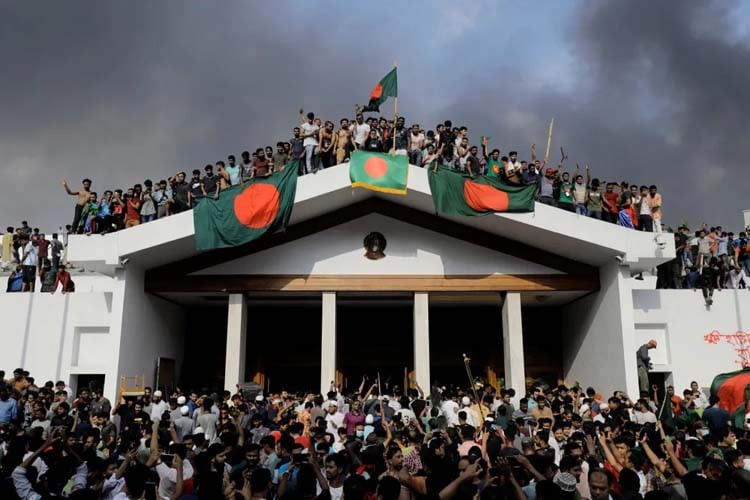
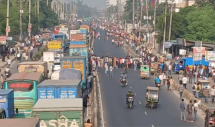
On August 5, millions of people took to the streets of Dhaka. All the streets were blocked in processions towards Ganabhaban, the official residence of dictator Hasina. Amid the massive mass-uprising, dictator Sheikh Hasina fled the country in fear of her life.
Nobel laureate Professor Dr. Muhammad Yunus was sworn -in as the chief advisor of a 17-member interim government on August 8.
On Saturday, August 10, Chief Adviser Professor Dr. Muhammad Yunus went to the house of Shaheed Abu Sayeed in Rangpur.
On August 10, Syed Refaat Ahmed was appointed as the chief justice.
On August 25, the Chief Adviser delivered an important maiden speech to the nation.
DEALING WITH FLOODS IN MID-AUGUST
Immediately after the interim government assumed office, a flash flood struck the eastern region of the country in late August. Twelve districts, including Feni, were submerged in the flood. The flood caused huge damage to property and loss of lives. The government took concerted steps to deal with this flood. People from all over the country, including the student movement, stood by the flood victims.
Due to the torrential rains that came down from Northeastern Indian state of Tripura and a few days of heavy rain, 11 districts of the country were hit by severe floods. The districts are – Feni, Cumilla, Noakhali, Lakshmipur, Brahmanbaria, Chattogram, Cox’s Bazar, Khagrachhari, Sylhet, Moulvibazar and Habiganj. Apart from this, Rangamati district was flooded.
198 WORLD LEADERS SUPPORT FOR DR. YUNUS
The people of Bangladesh and their chief adviser Dr. Muhammad Yunus have been strongly supported by 198 world leaders. Among them are former US President Barack Obama and at least 92 Nobel laureates.
On September 4, a report by the influential US media outlet Washington Post published a statement signed by the 198 world leaders.
In it, world leaders expressed their support for the interim government led by Dr. Muhammad Yunus and the people of Bangladesh, saying, ‘We extend our support and best wishes to Professor Muhammad Yunus, the chief adviser to the interim government of Bangladesh and Nobel laureate.’
They said, ‘Like others in Bangladesh, Professor Yunus has also been subjected to torture by the dictatorship. He took charge of the government after the dictatorial regime was overthrown through a student-led democratic movement.’
“We are proud to have supported Professor Yunus for years. This is the beginning of a new dawn in Bangladesh. We wish peace and success to the common people of Bangladesh in the days ahead.”
NAHID ISLAM IN TIME MAGAZINE’S 100 MOST INFLUENTIAL LIST
Nahid Islam, one of the coordinators of the anti-discrimination student movement in Bangladesh and information and broadcasting adviser, has been included in Time Magazine’s ‘Time 100 Next’ 2024 list.
This famous magazine publishes a list of the 100 most influential people in the world every year.
The list was published on October 2. Nahid Islam is in the Emerging Leaders category.
Time Magazine said about Nahid Islam: ‘He played a role in removing one of the most powerful persons in the world from power before he turned 26. Nahid Islam, who studied sociology, is one of the student leaders who launched a nationwide movement against Bangladeshi Prime Minister Sheikh Hasina.’
DR. MUHAMMAD YUNUS AMONG TOP 10 PERSONALITIES IN NATURE MAGAZINE
Interim government’s Chief Adviser Dr. Muhammad Yunus has been included in the list of top 10 personalities in the world-renowned science magazine Nature. Nature has called him a ‘nation builder’.
The report published on the Nature website on December 9 saying that this list is a recognition of how researchers are building the world by making important contributions in the fields of science, technology, engineering and medicine.
Initiative to publish a white paper on corruption and looting of Awami League regime
On August 21, the government announced the formation of a committee headed by economist Debapriya Bhattacharya to prepare a white paper.
On December 1, the committee submitted the white paper to the chief adviser. The white paper highlighted information about the illegal smuggling of $234 billion from Bangladesh through 28 ways of corruption in the last 15 years.
FIRE AT SECRETARIAT
The fire of this year occurred at the highly secured Secretariat complex on December 26. Documents of at least five ministries and divisions have been burned as fires ravaged part of Building-7 of the Secretariat for almost 10 hours.