
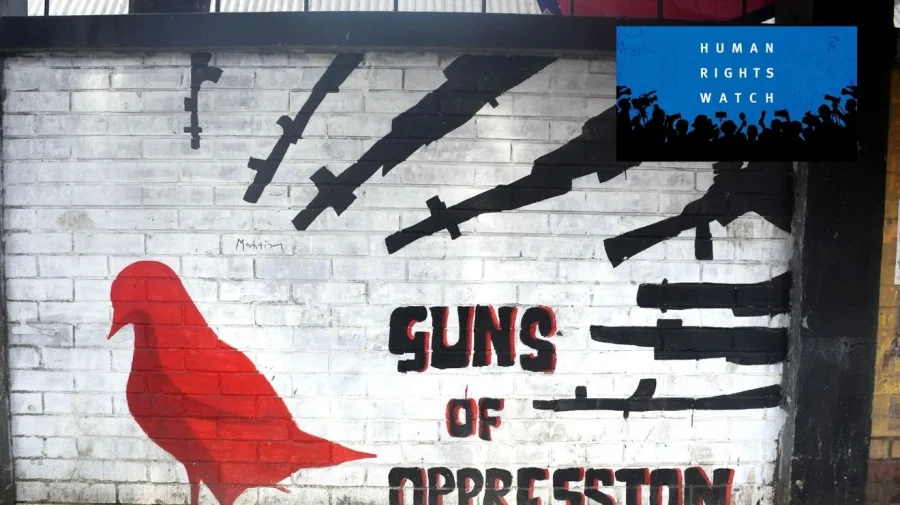
The political leadership directly instructed law enforcement to use excessive force during the mass protests of July 2024, according to a report by Human Rights Watch (HRW), one of the world’s leading human rights organizations. This information was revealed in a report published by HRW on January 27.
The report states, “Several police officers have said they believe they received orders for excessive use of force directly from political leadership during the protests.”
A delegation led by HRW’s Asia Director, Elaine Pearson, handed over the 50-page report titled Post-Monsoon Revolution: A Roadmap for Permanent Security Sector Reform in Bangladesh to Chief Adviser Professor Dr. Muhammad Yunus on Tuesday, January 28.
In an interview with HRW, a police officer remarked, “I believe that during that period of unrest, the role of the police was more dictated by political leaders than by field officers.”
Another officer stated, “We were instructed to fire even at people watching the protests from nearby houses. The main objective was to create fear and send a clear message that they should not even attempt to witness what was happening.”
The report highlights that police officers repeatedly received both direct and indirect instructions to use lethal force during the protests.
One officer explained, “Senior officials ordered us to show no leniency towards those creating ‘anarchy’ and to take strict action.”
He added, “Though they did not explicitly say ‘open fire,’ the instructions were clear—use maximum force, do whatever is necessary.”
The same officer revealed that senior officials at the Dhaka Metropolitan Police (DMP) headquarters monitored CCTV footage and directly instructed field officers to open fire as if playing a video game.
He further mentioned that Home Minister Asaduzzaman Khan and Inspector General of Police (IGP) Chowdhury Abdullah Al-Mamun issued these directives to Dhaka Metropolitan Police Commissioner Habibur Rahman, who then passed them on to Deputy Commissioners.
The report notes that this chain of command is consistent with the hierarchical structure of Bangladesh’s police force.
A video clip from August shows a police officer discussing protest suppression with the Home Minister, saying, “We shoot one, one dies. Another gets injured. Just one goes, sir. The rest do not dare. This is the ultimate form of fear.”
On July 26, six student movement coordinators, who were injured from excessive police force and attacks by ruling party supporters, were abducted by plainclothes officers from a hospital in Dhaka.
The report states that they were secretly detained for a week and forced to record a video statement declaring the end of the movement. However, they were released on August 1.
On August 5, Prime Minister Sheikh Hasina resigned and fled to India.
The report further details that after August 5, police were involved in several acts of violence.
For instance, on August 5, police set fire to a vehicle carrying wounded protesters in Ashulia. A witness reported that at least one individual was burned alive while in handcuffs.
Fifty-five-year-old Rajia Begum, an eyewitness, stated, “For the first time in my life, I saw innocent people being burned alive in this manner.”
She added that when neighbors attempted to extinguish the fire, police opened fire on them as well.
“The streets were flowing with blood,” Rajia said.
She further noted, “The shots were not aimed at legs but directly at people’s bodies.”


Design & Devlopment : Ifad Technology


