
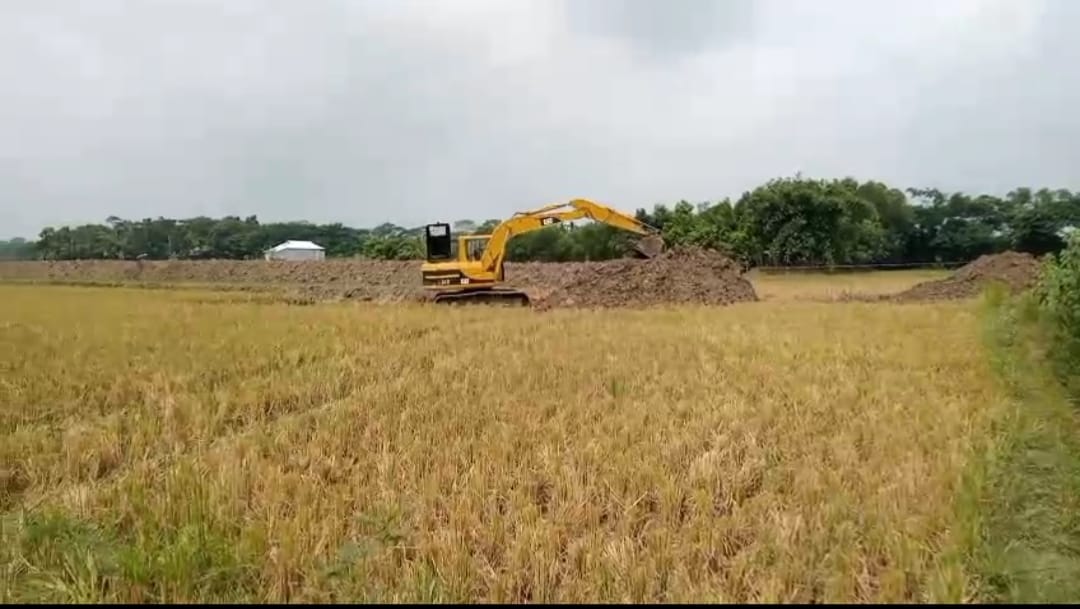
In Damudya upazila of Shariatpur, fertile croplands are rapidly being turned into fish farms. Across various areas of the upazila, influential individuals and groups are illegally converting agricultural land into fish enclosures, disregarding land classification rules and relevant laws. This blatant violation, met with a mysterious silence from the administration, is raising serious concerns among the locals. Such activities not only threaten food security but also disrupt the ecological balance.
A field visit revealed that hundreds of bighas of fertile land in several areas — including behind Nannu Bepari’s house at Anis Munshir Mor in Sidya Union, beside Hashem Howladar’s house in Char Malgao Bhaduri Kandi of Dhanokathi Union, and near the Gangaskathi Government Primary School in Purba Damudya and Islambur Unions — have now been brought under fish cultivation. The topsoil is being excavated to convert fields into deep ponds for retaining water.
However, according to the Land Conservation Act of 2001, changing the use of agricultural land requires government approval. These fish enclosures have neither such approval nor environmental clearance.
Abdul Malek, a farmer from Sidya, said, “A powerful local leader has built a fish enclosure next to my field. As a result, water drainage from our lands has been blocked. If no action is taken soon, we won’t be able to plant rice next season.”
Abu Kalam, a farmer from Dhanokathi Union, expressed his frustration, “I support my family by cultivating rice, jute, and chili. Now, they are digging fish enclosures right next to my land. Soon, water will get trapped, and then what will I do? If we can’t farm, how will we survive?”
Another farmer, Kabir Hossain, said, “They are seizing lands and excavating soil under the cover of night. Even when we protest, they don’t listen. They’ve taken over people’s lands for the enclosures, and the embankments they build by cutting soil will cause rainwater to accumulate in surrounding fields. We grow crops with loans and debts. Now, these lands will no longer be cultivable.”
Concerned citizens are questioning the role of the upazila administration. The administration’s silence, combined with political influence, seems to be granting unofficial legitimacy to these illegal activities — posing a serious threat to agriculture and the environment. Experts warn that if agricultural land is not protected, a food crisis is inevitable. If the once-green rice fields turn into fish farms, the nation’s food production system will face severe jeopardy.
Local agriculturist Md. Rashedul Islam remarked, “The soil in Shariatpur is extremely fertile, supporting the cultivation of rice, jute, potatoes, and various crops. The destruction of agricultural land will not only lead to a food crisis but also cause environmental disasters. If this trend continues, the consequences for future generations will be catastrophic.”
An official from the Upazila Agriculture Office, speaking anonymously, admitted, “We’re aware of the issue, but unless there’s an order from ‘above’, we can’t take action.”
Meanwhile, acting Upazila Nirbahi Officer (UNO) Md. Abdul Malek stated, “The matter is being investigated. Necessary actions will be taken.”









Design & Devlopment : Ifad Technology


