
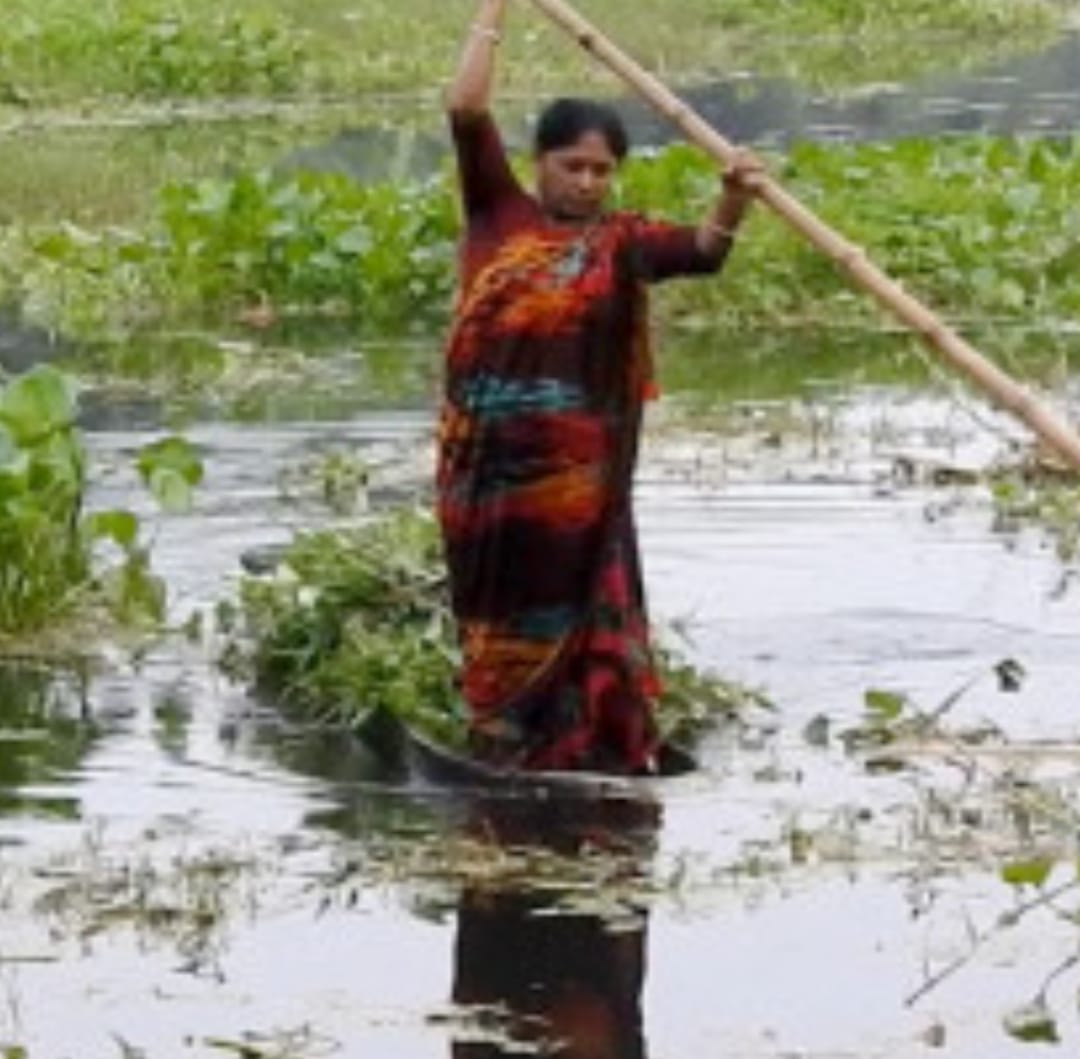
The wetland areas of southern Narail Sadar Upazila have now become a center of unique livelihoods for women. From dawn till dusk, they float on palm-tree canoes across the waters of the wetlands. Their days revolve around collecting water lilies, gathering kolmi shak (water spinach), and fishing—earning their daily bread. For the women of Lanch Beel, the monsoon season has come as a blessing!
Sabita Adhikari, a woman in her fifties from Guakhola village, begins her day by rowing out on a self-made canoe into Debbhog Beel. After hours of gathering water lilies, she returns home to cook, tend to her livestock, and again sets out in the afternoon in search of fodder. For her, the beel and her small palm-tree canoe have become constant companions in life.
But it is not just Sabita Adhikari—many women from Maliyat, Shimulia, Muliat, and Hatiara villages are also engaged in such wetland-based livelihoods. Their daily routines involve collecting water lilies and kolmi shak in the morning, and fishing with hooks and lines later on. Those who catch more fish sell them in the market, while others meet their families’ needs first.
Sixty-year-old Kalpana Biswas shared: “I have been doing this work for 40 years. Earlier, I worked with my husband, but now I do it alone. My household runs on the water lilies I collect. I have no land, no house. Government aid goes to landowners; we, the landless, are deprived.”
She further said that twice a week she sells her water lilies at Tularampur market and twice at Rupganj market, while sometimes middlemen buy directly from her home.
On average, these women collect 80 to 100 bundles of water lilies daily. Each bundle contains about 20 lilies and sells for 5 taka. This means they earn between 300 to 500 taka a day. Depending on water levels, this struggle for livelihood continues either year-round or from May to October.
The primary vessel of this livelihood is the small canoe made from palm trees, locally known as donga. Traditionally used by men, here women have mastered rowing the donga with equal skill, carving out a path for both their lives and livelihoods.
Amar Mondol, a trader from Jashore who buys water lilies, said: “I purchase water lilies from Guakhola and Hatiara three times a week and sell them at Monirampur. I’ve been in this trade for ten years—my family also survives on these lilies.”
Narail Sadar Upazila Agriculture Officer, Md. Roknuzzaman, said: “A huge amount of water lilies grow naturally in the wetlands. They are highly nutritious and have become a popular food item. People of all ages are now engaged in this work, especially women, who are becoming self-reliant through their earnings.”







Design & Devlopment : Ifad Technology


