
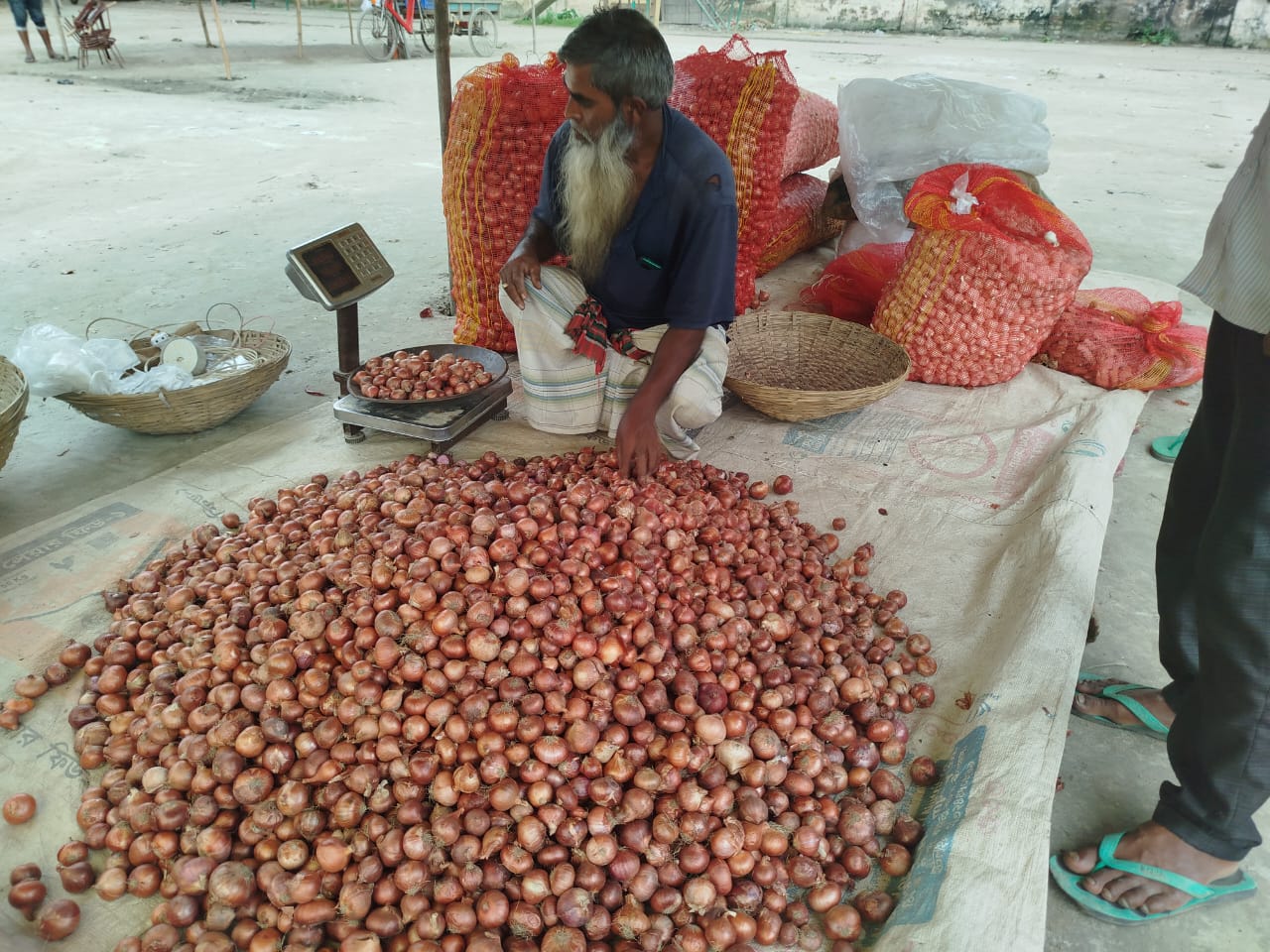
Prices of essential items—onion, garlic, and ginger—have become increasingly unstable in Lalmonirhat’s kitchen markets, causing significant strain on consumers. For over two weeks, the prices of these three items have been rising steadily.
On Saturday (30 August), a visit to the Sialkhowa kitchen market revealed that both local and Indian onions were selling at BDT 70–80 per kilogram. While local garlic was relatively affordable (BDT 90–120), imported garlic was nearly double the price (BDT 140–160). Local ginger was priced at BDT 150–170 per kilogram. In contrast, potato prices remained stable, with local varieties selling at BDT 20–25.
Local traders stated that although local onion production is sufficient, increased production costs have pushed up wholesale prices. Meanwhile, irregular imports of Indian onions have reduced market supply, adding pressure on prices.
Onion vendor Shariful Islam said, “There’s plenty of local onion, but farmers are selling at higher rates. Indian onions don’t arrive consistently either, which is causing market instability.”
Garlic and ginger trader Kalam Mia added, “Garlic and ginger are mostly import-dependent. Any disruption in imports leads to market volatility. We don’t set the prices ourselves—we rely on the wholesale market.”
Consumers are struggling with daily price fluctuations of essential goods. They complain that there is no effective market regulation.
Homemaker Shahnaz Parveen said, “Cooking without onion and garlic isn’t an option. We’re forced to buy at high prices, and managing monthly expenses has become difficult.”
Another shopper, Mominul Haque, said, “The market has been unstable for over a month. The government should take immediate action.”
Demand for Market Monitoring
Consumers believe that both supply shortages and artificial influence by traders are driving the high prices. They have called for stronger market oversight to stabilize prices. Without it, the essential goods market may become even more unbearable for the general public.









Design & Devlopment : Ifad Technology


