
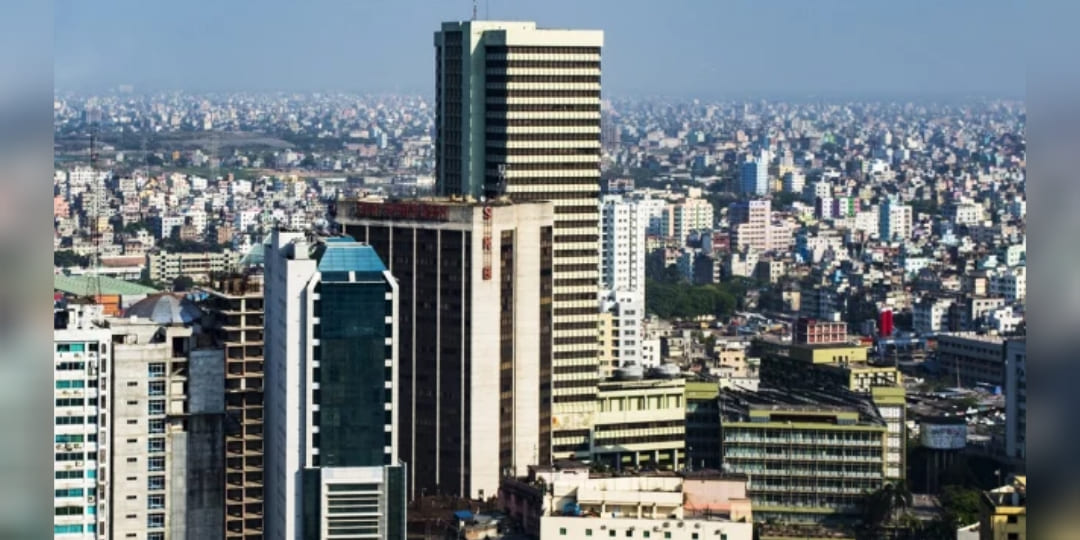
A staggering 2.1 million out of 2.2 million buildings in areas under Rajuk’s jurisdiction—spanning 1,528 square kilometers—stand on weak foundations due to non-compliance with building codes, outdated designs, and violations of approved blueprints. Alarmingly, 37% of newly constructed government buildings have also been identified as vulnerable.
Rajuk’s statistics show that while about 1.5 million two-storey or smaller buildings pose relatively lower risk, approximately 600,000 buildings ranging from four to thirty storeys fall in the high-risk category. Urban planners warn that a major earthquake could trigger a catastrophic disaster in the capital.
Following three earthquakes in the last two days, Rajuk has begun emergency inspections of dangerous buildings. During a visit to Banshal on Saturday, Rajuk Chairman Engineer M. Riazul Islam said,
“Most buildings in Old Dhaka are unsafe. Many six- or seven-storey structures have been built on less than one katha of land without any planning.”
Environmental activist Syeda Rizwana Hasan told reporters in Mirpur on Friday that nearly 90% of Old Dhaka’s buildings were constructed without adhering to building codes. She warned,
“The recent earthquakes are a clear alarm. Dhaka, especially Old Dhaka, is now at extreme risk.”
Surveys by Dhaka North and South City Corporations reveal that most buildings are 20–30 years old, built with questionable steel and cement quality, and often expanded beyond approved designs. A professor from Dhaka University’s Department of Disaster Science noted that soil conditions in many areas are unsuitable for high-rise construction, worsening risks for unauthorized structures.
Experts say most buildings lack earthquake-resistant design, safety zones, and open spaces. Narrow alleys, dense high-rises, and unplanned utility lines also heighten the risk of post-quake fires.
According to Rajuk, 74% of buildings in Dhaka were constructed without following approved designs. Despite directives to demolish high-risk structures, enforcement remains largely absent.
At a seminar organized by the Safety Awareness Foundation, it was reported that 2,146,000 buildings in Dhaka are classified as vulnerable, including numerous schools and the new 17-storey building of the Bangladesh Medical University. A World Bank–assisted survey found 37% of new government buildings structurally unsafe.
Urban planners further note that 13% of Dhaka’s land is legally designated as non-buildable, yet construction continues unabated—making the city increasingly perilous for residents.






Design & Devlopment : Ifad Technology


