
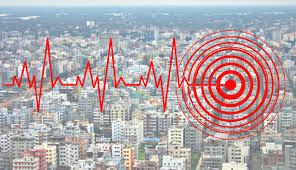
Bangladesh has experienced six earthquakes in the past seven days, four of which originated in the Palash and Shibpur areas of Narsingdi district. The most recent tremor, measuring 3.6 on the Richter scale, was felt at 4:16 p.m. on Thursday (27 November) in Ghorashal, Narsingdi.
Earlier on Wednesday night, a 4.0-magnitude earthquake struck Teknaf in Cox’s Bazar, with its epicenter located under the Bay of Bengal. Around the same time, another earthquake in Imphal, Manipur, India, was felt in Sylhet. Residents in the capital’s Badda area were also alarmed by a separate tremor.
Experts say that the frequent earthquakes in Narsingdi may indicate the presence of a fault line beneath the region. Dr. Mehedi Ahmed Ansary, a professor at Bangladesh University of Engineering and Technology (BUET), said that the recent minor tremors are likely aftershocks following the strong quake on 21 November. He warned that the possibility of a major earthquake in the future cannot be ruled out.
Canada-based earthquake expert Mostafa Kamal Palash suggested that the Madhupur Fault might extend southward through Narsingdi. He recommended installing GPS-based monitoring systems in earthquake-prone zones to obtain clearer information about the location and risk level of fault lines.









Design & Devlopment : Ifad Technology


