
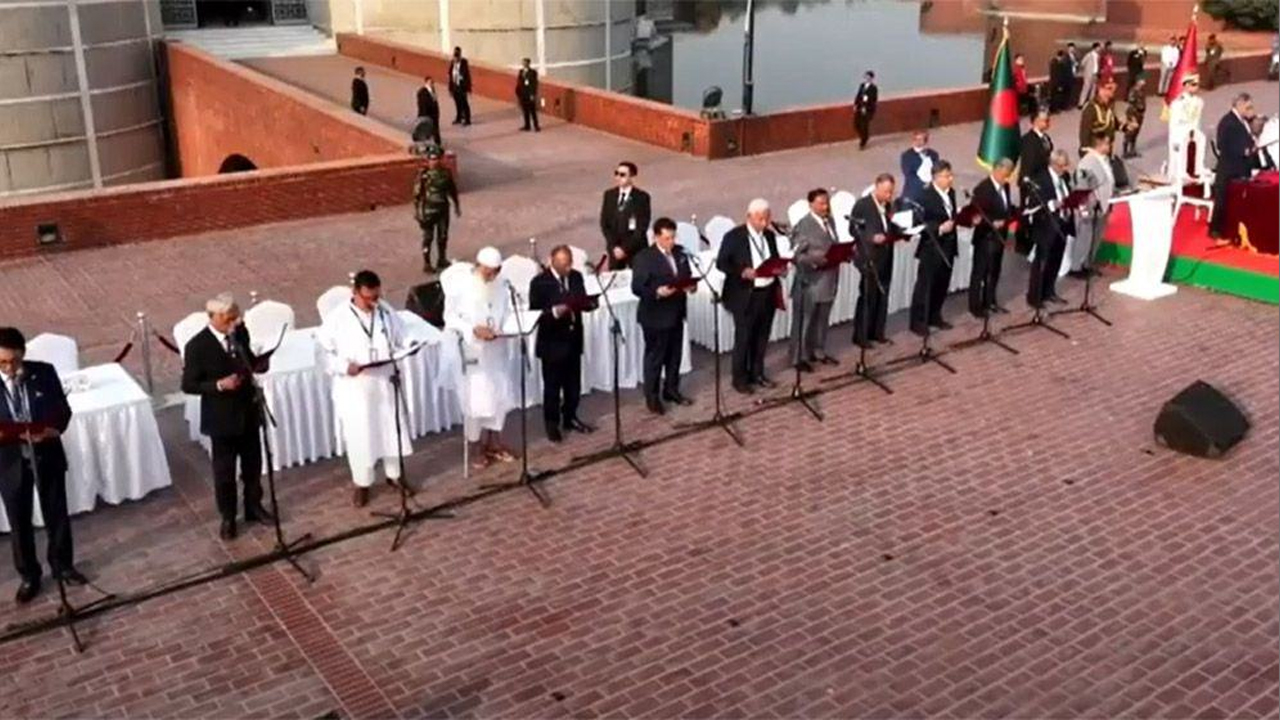
After the oath-taking, the Cabinet Division issued a gazette appointing the Prime Minister and other members of the cabinet. The gazette was issued late at night on Tuesday (17 February).
Earlier on Tuesday BNP Chairperson Tarique Rahman took oath as Prime Minister at the South Plaza of the National Parliament Bhaban. At the same time, the President, Md. Shahabuddin, administered the oath to 25 ministers and 24 state ministers.
Subsequently, through the Cabinet Division’s gazette on appointments and allocation of portfolios, the formation of the new 50-member cabinet was completed. Through this, the BNP formed the government for the fourth time after 20 years. BNP Chairperson Tarique Rahman became Prime Minister for the first time.
Three ministries/divisions under the Prime Minister: In the new cabinet, the Prime Minister has kept the Cabinet Division, the Ministry of Defence, and the Armed Forces Division under his authority.
Portfolios allocated to ministers:
1. Mirza Fakhrul Islam Alamgir – Ministry of Local Government, Rural Development and Co-operatives
2. Amir Khasru Mahmud Chowdhury – Ministry of Finance, Ministry of Planning
3. Salahuddin Ahmed – Ministry of Home Affairs
4. Iqbal Hasan Mahmud – Ministry of Power, Energy and Mineral Resources
5. Hafiz Uddin Ahmed (Bir Bikram) – Ministry of Liberation War Affairs
6. Abu Zafar Md. Zahid Hossain – Ministry of Women and Children Affairs and Ministry of Social Welfare
7. Dr. Khalilur Rahman – Ministry of Foreign Affairs
8. Abdul Awal Mintoo – Ministry of Environment, Forest and Climate Change
9. Kazi Shah Mofazzal Hossain Kaykobad – Ministry of Religious Affairs
10. Mizanur Rahman Minu – Ministry of Land
11. Nitai Roy Chowdhury – Ministry of Cultural Affairs
12. Khandaker Abdul Muktadir – Ministry of Commerce, Ministry of Industries, and Ministry of Textiles and Jute
13. Ariful Haque Chowdhury – Ministry of Labour and Employment, Ministry of Expatriates’ Welfare and Overseas Employment
14. Jahir Uddin Swapan – Ministry of Information and Broadcasting
15. Mohammad Amin Ur Rashid – Ministry of Agriculture, Ministry of Fisheries and Livestock, and Ministry of Food
16. Afroza Khanam Rita – Ministry of Civil Aviation and Tourism
17. Md. Shahid Uddin Chowdhury Anni – Ministry of Water Resources
18. Asadul Habib Dulu – Ministry of Disaster Management and Relief
19. Md. Asaduzzaman – Ministry of Law, Justice and Parliamentary Affairs
20. Zakaria Taher – Ministry of Housing and Public Works
21. Dipen Dewan – Ministry of Chittagong Hill Tracts Affairs
22. A N M Ehsanul Haque Milon – Ministry of Education and Ministry of Primary and Mass Education
23. Sardar Md. Sakhawat Hossain (Bakul) – Ministry of Health and Family Welfare
24. Fakir Mahbub Anam – Ministry of Posts, Telecommunications and Information Technology, Ministry of Science and Technology
25. Sheikh Robiul Alam – Ministry of Road Transport and Bridges, Ministry of Railways, and Ministry of Shipping
Portfolios allocated to state ministers:
1. M Rashiduzzaman Millat – Ministry of Civil Aviation and Tourism
2. Anindya Islam Amit – Ministry of Power, Energy and Mineral Resources
3. Md. Shariful Alam – Ministry of Commerce, Ministry of Industries, and Ministry of Textiles and Jute
4. Shama Obaid Islam – Ministry of Foreign Affairs
5. Sultan Salauddin Tuku – Ministry of Agriculture, Ministry of Fisheries and Livestock, and Ministry of Food
6. Barrister Kaiser Kamal – Ministry of Land
7. Farhad Hossain Azad – Ministry of Water Resources
8. Md. Aminul Haque – Ministry of Youth and Sports
9. Mir Mohammad Helal Uddin – Ministry of Chittagong Hill Tracts Affairs
10. Habibur Rashid – Ministry of Road Transport and Bridges, Ministry of Railways, and Ministry of Shipping
11. Md. Rajib Ahsan – Ministry of Road Transport and Bridges, Ministry of Railways, and Ministry of Shipping
12. Md. Abdul Bari – Ministry of Public Administration
13. Mir Shahe Alam – Ministry of Local Government, Rural Development and Co-operatives
14. Md. Junaid Abdur Rahim Saki (Junaid Saki) – Ministry of Finance and Ministry of Planning
15. Ishraq Hossain – Ministry of Liberation War Affairs
16. Farzana Sharmin – Ministry of Women and Children Affairs and Ministry of Social Welfare
17. Sheikh Faridul Islam – Ministry of Environment, Forest and Climate Change; Ministry of Religious Affairs; and Ministry of Law, Justice and Parliamentary Affairs
18. Md. Nurul Haque Nur (VP Nur) – Ministry of Labour and Employment and Ministry of Expatriates’ Welfare and Overseas Employment
19. Yaser Khan Chowdhury – Ministry of Information and Broadcasting
20. M Iqbal Hossain – Ministry of Disaster Management and Relief
21. M A Muhith – Ministry of Health and Family Welfare; Ministry of Posts, Telecommunications and Information Technology; and Ministry of Science and Technology
22. Ahmad Sohel Manjur – Ministry of Housing and Public Works
23. Bobby Hajjaj – Ministry of Education and Ministry of Primary and Mass Education
24. Ali Nawaz Mahmud Khaiyam – Ministry of Cultural Affairs
On 12 February, voting was held for the 13th National Parliament Election. Securing a two-thirds majority, the BNP achieved an absolute majority. Out of 299 seats, results for 297 seats were declared. Of these, the BNP alliance won 212 seats. Bangladesh Jamaat-e-Islami and the NCP alliance secured 77 seats, while independents and others won 8 seats.
On Tuesday (17 February), the newly elected Members of Parliament took oath. Later, at the parliamentary party meeting, BNP Chairperson Tarique Rahman was elected as Leader of the House and Prime Minister. Subsequently, in the afternoon, BNP Chairperson Tarique Rahman went to the South Plaza of the National Parliament Bhaban. There, President Md. Shahabuddin decided to appoint him as Prime Minister. At the same time, the President gave consent to form a new cabinet under Tarique Rahman’s leadership. The members of the new cabinet then took oath.


Design & Devlopment : Ifad Technology


