
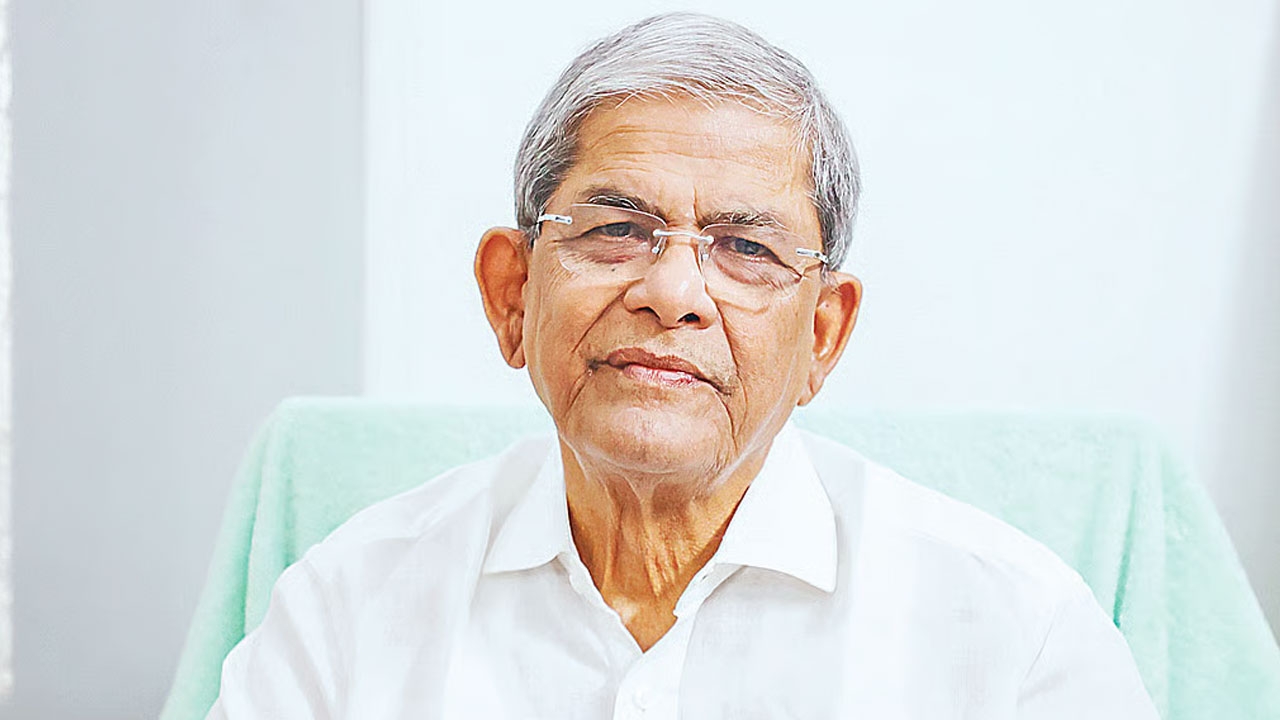
Following the resignation of Bangladesh’s 22nd President, Mohammed Shahabuddin, last Friday (July 24), discussions have intensified over who will become the country’s next president. According to the report, BNP Secretary General Mirza Fakhrul Islam Alamgir has emerged as the leading contender.
The report states that Mirza Fakhrul, who is currently serving as the Minister of Local Government, Rural Development and Cooperatives, is receiving the most attention among several senior BNP leaders because of his political experience and reputation.
Sources cited in the report claim that his broad acceptability, foresight, extensive experience in party and state affairs, and balanced leadership have placed him at the center of discussions. A significant section of the BNP reportedly supports his nomination for the presidency. The report further says that, during times of political uncertainty, a capable and non-controversial president is considered essential for maintaining stability. It adds that the BNP’s National Standing Committee is expected to make the final decision.
Political analysts quoted in the report argue that, after returning to power following more than a decade and a half in opposition, the BNP leadership would likely prefer a president who can provide steady leadership during times of crisis and command broad public acceptance. The report concludes that Mirza Fakhrul is expected to become Bangladesh’s 23rd president, although it notes that he declined to comment on the matter.
Mirza Fakhrul has served as BNP Secretary General for more than a decade. The report highlights his role in leading the party during difficult times, representing it internationally, and serving as its principal spokesperson. It credits his measured public statements and calm political strategy with earning him respect across party lines. It also notes his role in fostering national political consensus among different parties.
The report recalls that Mohammed Shahabuddin took office as Bangladesh’s 22nd president on April 24, 2023, after being elected unopposed with the nomination of the Awami League. His five-year term was scheduled to end in April 2028. It further recounts that following the mass uprising of August 5, 2024, which led to the fall of the Awami League government and the departure of then-Prime Minister Sheikh Hasina, Shahabuddin continued serving as president during the subsequent political transition, including the dissolution of parliament and the formation of an interim government. According to the report, after his resignation last Friday, the Speaker of Parliament assumed the role of Acting President.
The report says there are three main reasons why Mirza Fakhrul is considered the frontrunner. It points to his long-held aspirations for the release of former Prime Minister Begum Khaleda Zia, the return of BNP Chairman Tarique Rahman to Bangladesh, and the BNP’s return to power through a free and fair election—all of which, it says, have now been realized. It argues that his political sacrifices, clean public image, and domestic and international credibility have strengthened his candidacy.
The report further portrays Mirza Fakhrul as one of the BNP’s most trusted leaders, describing him as modest, principled, and free from corruption allegations throughout his political career. It says he maintained party unity during some of its most difficult years and continued to lead despite numerous legal cases, arrests, and political pressure. His loyalty to the Zia family and organizational leadership are presented as key factors behind his standing within the party.
According to the report, his reputation for moderation, inclusive politics, and opposition to extremism has earned him broad public acceptance. It also claims he enjoys the confidence of minority communities, civil society, and the diplomatic community, qualities that supporters believe would make him an effective head of state.
The report outlines his background, noting that Mirza Fakhrul was born in Thakurgaon in 1948 into a prominent political family. His father, the late Ruhul Amin Chokha Mia, served as a deputy minister for agriculture. His uncle, Mirza Golam Hafiz, served as Speaker of Parliament and later as Minister for Law, Justice and Parliamentary Affairs.
It also summarizes his career, stating that he joined the Bangladesh Civil Service (Education Cadre) in 1972 as a lecturer in economics at Dhaka College, later taught at several government colleges, and worked as an auditor in the government. He subsequently served as personal secretary to Deputy Prime Minister S. A. Bari, returned to academia, and was elected to Parliament from Thakurgaon-1 in the 2001 general election. He later served as State Minister for Agriculture and then State Minister for Civil Aviation and Tourism.
Several academics are quoted in the report as saying that Bangladesh should elect a president with integrity, administrative experience, constitutional knowledge, and broad public confidence. While acknowledging that the BNP has several senior leaders, they argue that a seasoned politician capable of making sound decisions during crises would be the most suitable choice, and they identify Mirza Fakhrul as meeting those criteria.
The report concludes by stating that the Chief Election Commissioner, A. M. M. Nasir Uddin, and other election commissioners are scheduled to meet the Acting Speaker regarding the announcement of the presidential election schedule. Under Bangladesh’s constitutional procedure, the president is elected by members of parliament, and the Election Commission will prepare the electoral roll based on the list of MPs provided by the Parliament Secretariat before announcing the election schedule.





Design & Devlopment : Ifad Technology


