
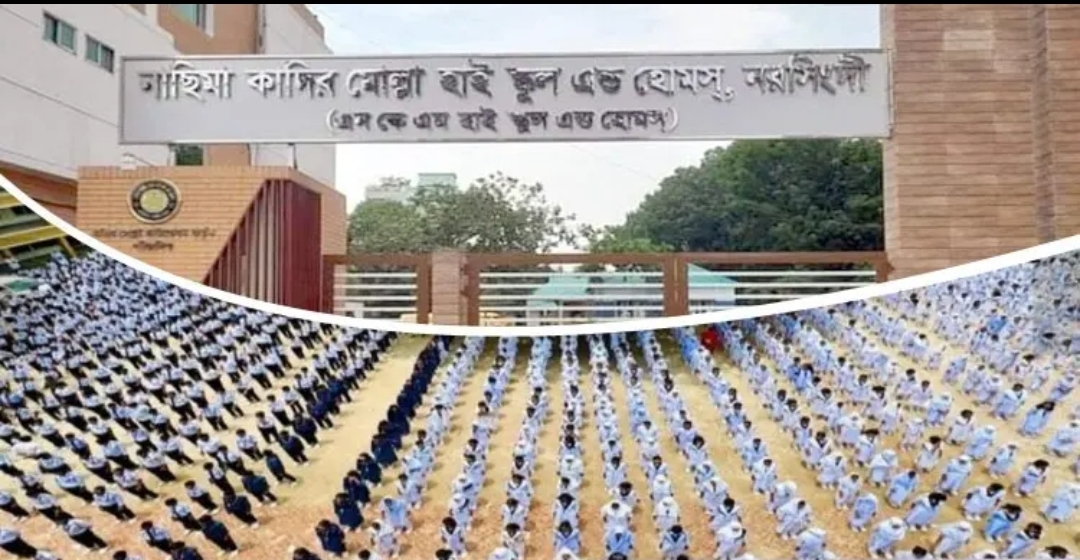
Nasima Kadir Molla High School and Homes in Narsingdi is one of the country’s much-discussed educational institutions when it comes to academic results. In the 2026 SSC examination, all 382 students from the institution reportedly achieved GPA-5, creating an atmosphere of celebration among teachers, students and parents.
But behind this picture of success lies a different reality.
Of the 601 students registered in Class Nine in the same cohort, only 382 eventually got the opportunity to sit for the SSC examination. In other words, 219 students dropped out between Class Nine and the SSC examination.
The question now is: Why did such a large number of students drop out?
Some parents allege that the school’s selection or test examination was used as a tool to screen students. Students who performed poorly were allegedly denied the opportunity to fill out the SSC examination forms. As a result, only relatively high-performing students were sent to the board examination, helping the institution achieve an enviable result while leaving many of the excluded students facing uncertainty about their education.
The school authorities, however, have denied these allegations. They say students who failed the test examination were given another opportunity to sit for a retest. Only those who failed to achieve the required standard even after the retest were unable to participate in the SSC examination.
According to information from the Dhaka Education Board, 601 students were registered in Class Nine at Nasima Kadir Molla High School and Homes in 2024.
After the annual examination, 483 students were promoted to Class Ten. This means 118 students were eliminated before moving from Class Nine to Class Ten.
The students then took the Class Ten selection or test examination. According to the school authorities, 169 students initially failed in one or more subjects. Following applications from their parents, they were given another opportunity to sit for the examination. Of them, 68 students passed the retest.
According to the school’s records, 101 students ultimately failed to achieve the required standard in the selection examination.
Thus, out of the 601 students originally registered in Class Nine, only 382 eventually became SSC examinees. A total of 219 students were left out along the way.
This figure has become the biggest question surrounding the institution: If nearly 36% of the students in a cohort were unable to reach the SSC examination, how should the institution’s 100% GPA-5 result be evaluated?
Some parents allege that students were screened out through difficult test questions and strict marking.
They claim that answers or solutions that would normally receive relatively high marks in the board examination were given lower marks in the school’s selection examination. As a result, many students failed to achieve the expected scores.
The parents further allege that the school did not merely seek to ensure that students passed the test; it selected students considered capable of achieving good results and sent them to the SSC examination. This, they say, helped the institution produce an outstanding board-examination result.
However, the school’s Assistant Head Teacher, Mohammad Kamal Hossain, has categorically rejected the allegations.
According to him, 169 students initially failed in one or more subjects in the test examination. Following demands from their parents, a retest was arranged. Sixty-eight students passed that examination. The remaining 101 failed to achieve the required standard and therefore could not participate in the SSC examination.
The school authorities also claim that complaints regarding the matter were submitted to the then Narsingdi district administration. An investigation committee visited the school and reviewed answer scripts and relevant documents. According to the school, the committee found no irregularities.
One parent alleged that their child had studied at the school since Class Five. The student had regularly passed Classes Six, Seven, Eight and Nine but failed the test examination after reaching Class Ten.
The parent questioned why the responsibility for the failure should fall solely on the student after the school had taught the child for years.
Another parent made a more direct allegation.
According to the parent, if an educational institution focuses only on students capable of producing good results and excludes weaker students, then how much of the credit for a 100% GPA-5 result should actually go to the institution?
The parent said that a student who fails to achieve GPA-5 can still pass successfully and build a successful future. Why, then, should an entire academic year be lost simply because of examination results?
The school authorities say that 314 students passed the selection examination initially, while another 68 passed the retest.
But another question has emerged here as well.
How did students who had struggled to pass the selection examination manage to achieve GPA-5 in the SSC examination just a few months later?
The school authorities have an explanation for this too.
Assistant Head Teacher Mohammad Kamal Hossain said that special preparation programmes were arranged for students following the selection examination. Classes were conducted in different shifts from 6am to 10:30pm. Teachers were divided into groups and provided students with intensive academic support.
He claimed that this special attention from teachers, combined with the students’ hard work, resulted in the extraordinary SSC performance.
The discussion surrounding Nasima Kadir Molla School is also rooted in its consistent academic success.
According to school sources, students of the institution achieved 100% GPA-5 results in 2017, 2022, 2025 and 2026.
The institution attracted renewed attention particularly in 2026, when all 382 examinees reportedly secured GPA-5.
At the same time, however, the revelation that 219 out of the 601 students registered in Class Nine did not make it to the SSC examination has raised questions about the method behind the institution’s success.
This raises the most important question: If a student fails the selection or test examination, can the student be prevented from filling out the SSC examination form?
According to Dhaka Education Board Chairman Professor Syed Akhtaruzzaman, there is no scope for turning the selection examination into a tool for screening students.
According to him, once a student has taken the test examination, the student should be given the opportunity to fill out the SSC examination form. A student cannot be excluded from the board examination solely on the basis of the test-examination result.
He also said that the Education Board would review the results and student-selection practices of institutions achieving 100% pass rates or 100% GPA-5 results. If necessary, the heads of the institutions would be summoned and asked to provide explanations.
This means the allegations surrounding Nasima Kadir Molla School are no longer merely a dispute between parents and the institution; the matter has also drawn the attention of education authorities.
Educationists say that looking only at board-examination results does not provide a complete picture of an institution’s quality.
It is equally important to examine how many of the students originally enrolled at an institution ultimately sit for public examinations, how many drop out along the way, and what kind of support the institution provides to students who fall behind.
Professor Emeritus Dr. Manzoor Ahmed of BRAC University believes that when a student fails to achieve the expected result, the responsibility cannot simply be placed on the student.
According to him, instead of excluding a student before the examination after teaching them for several years, institutions should identify why the student is falling behind and provide the necessary support. At the same time, the Education Board and administration need to ensure effective oversight of such matters.
He believes the purpose of assessment should be to determine what a student has learned and where the student is struggling, rather than using a simple ‘pass’ or ‘fail’ result to push the student out of the education system.
A 100% GPA-5 result is undoubtedly an achievement worth celebrating. But if hundreds of students disappear from the education process along the way, then alongside the impressive numbers, the stories of those excluded students also need to be brought to light.
Because the fundamental purpose of education is not merely to achieve the highest marks in an examination; it is to help every student progress according to their individual potential.
The 2026 results of Nasima Kadir Molla School have therefore presented two contrasting pictures.
On one side are 382 students, all of whom achieved GPA-5.
On the other are 219 students from the same cohort who did not make it to the SSC examination.
The question now is a simple one:
Should an institution’s success be measured solely by the results of those who reached the examination hall—or should the students who never made it to the examination door also be counted in the equation of success?
The answer to this question is important not only for Nasima Kadir Molla School, but also for how the performance of educational institutions across Bangladesh should be evaluated.







Design & Devlopment : Ifad Technology


