
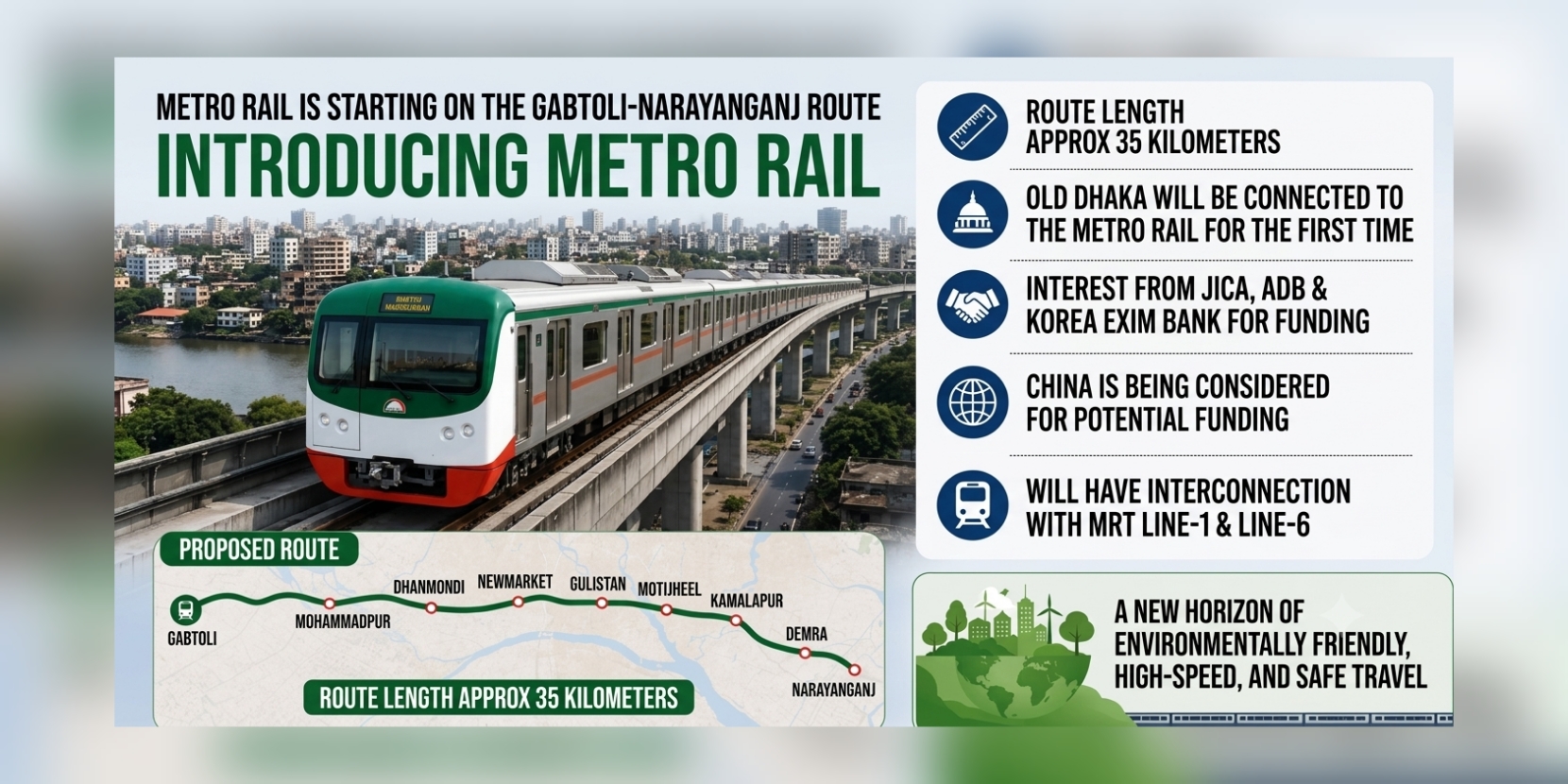
The government is planning to introduce a metro rail service from Gabtoli, on the western edge of the capital, to Narayanganj via Old Dhaka. If implemented, the proposed route, approximately 35 kilometres long, would create a direct connection between Old Dhaka and the existing metro rail network for the first time.
The preliminary estimated cost of the proposed MRT Line-2 is Tk 60,836 crore. Of this, Tk 45,626 crore is planned to come from foreign loans, while the remainder would be financed from government funds. At the current exchange rate, the total project cost is approximately US$5.2 billion.
According to the initial plan, the metro rail would run from Gabtoli through Dhaka Udyan, Mohammadpur, Jigatola, Science Laboratory, New Market, Azimpur, Dhaka Medical College, Gulistan, Motijheel, Kamalapur, Demra and Signboard to Narayanganj Sadar. A branch line from Gulistan to Nayabazar and Sadarghat has also been proposed.
If implemented, the branch line would bring major commercial and densely populated areas of Old Dhaka under the rapid transit network. It could also improve access to Sadarghat river port, wholesale markets, hospitals and educational institutions.
Officials say the proposed MRT Line-2 could create an important link between existing and planned metro rail routes in the capital. Interchange facilities are planned with MRT Line-5 Northern at Gabtoli and MRT Lines 1 and 6 at Kamalapur, among other connections. This would allow passengers to travel more easily across Dhaka by using multiple metro rail lines.
According to sources at the Planning Commission, Economic Relations Division (ERD) and Dhaka Mass Transit Company Limited (DMTCL), the project’s financing arrangement has not yet been finalised. Several development partners, including the Japan International Cooperation Agency (JICA), Asian Development Bank (ADB) and Korea’s Export-Import Bank, have reportedly shown interest in providing financing. Discussions with China may also be considered as a potential source of funding.
Officials have said that, before taking foreign loans, factors such as interest rates, grace periods, repayment periods and other financial terms will need to be carefully assessed. The government is also reviewing whether the project should be implemented in full, partially, or with modifications based on requirements.
According to information from the updated transport plan, passenger demand along the Gabtoli–Narayanganj corridor could be substantial. Under different scenarios, daily ridership could exceed one million passengers, with demand potentially reaching around 1.4 million passengers under the highest-demand scenario.
The project’s passenger potential is considered particularly strong because it would connect densely populated and economically important areas such as Mohammadpur, Dhanmondi, New Market, Gulistan, Motijheel, Old Dhaka and Narayanganj along a single corridor.
The project design is expected to incorporate both elevated and underground sections. Underground construction is being considered for the densely populated and historically significant areas of Old Dhaka. Elevated sections, meanwhile, are planned for comparatively wider roads and newly developed urban areas. Preliminary work to identify land for a depot in Demra and Matuail has also progressed.
International cooperation is also being discussed for the project’s feasibility study, design and tender preparation. According to sources, the World Bank has expressed interest in providing technical assistance for the feasibility study, preliminary and detailed designs, and preparation of tender documents.
Transport experts believe that the introduction of metro rail along the Gabtoli–Narayanganj corridor could reduce long-standing traffic congestion and ease pressure on slow-moving road transport. It could also encourage people to shift from private cars and buses to public transport. This, in turn, could reduce travel times as well as air and noise pollution.
However, economists and transport experts have urged caution over the project’s high cost and potential debt burden. They argue that while expanding the metro rail network may be necessary, the government should conduct a realistic assessment of the expected economic benefits, passenger demand, operating costs and its capacity to repay the loans before making a major investment decision.
Meanwhile, the government is also considering the possibility of implementing large infrastructure projects through public-private partnerships (PPP) to reduce pressure from borrowing. As a result, the financing structure ultimately chosen for MRT Line-2 is likely to be one of the key issues in the project’s next phase.



Design & Devlopment : Ifad Technology


