
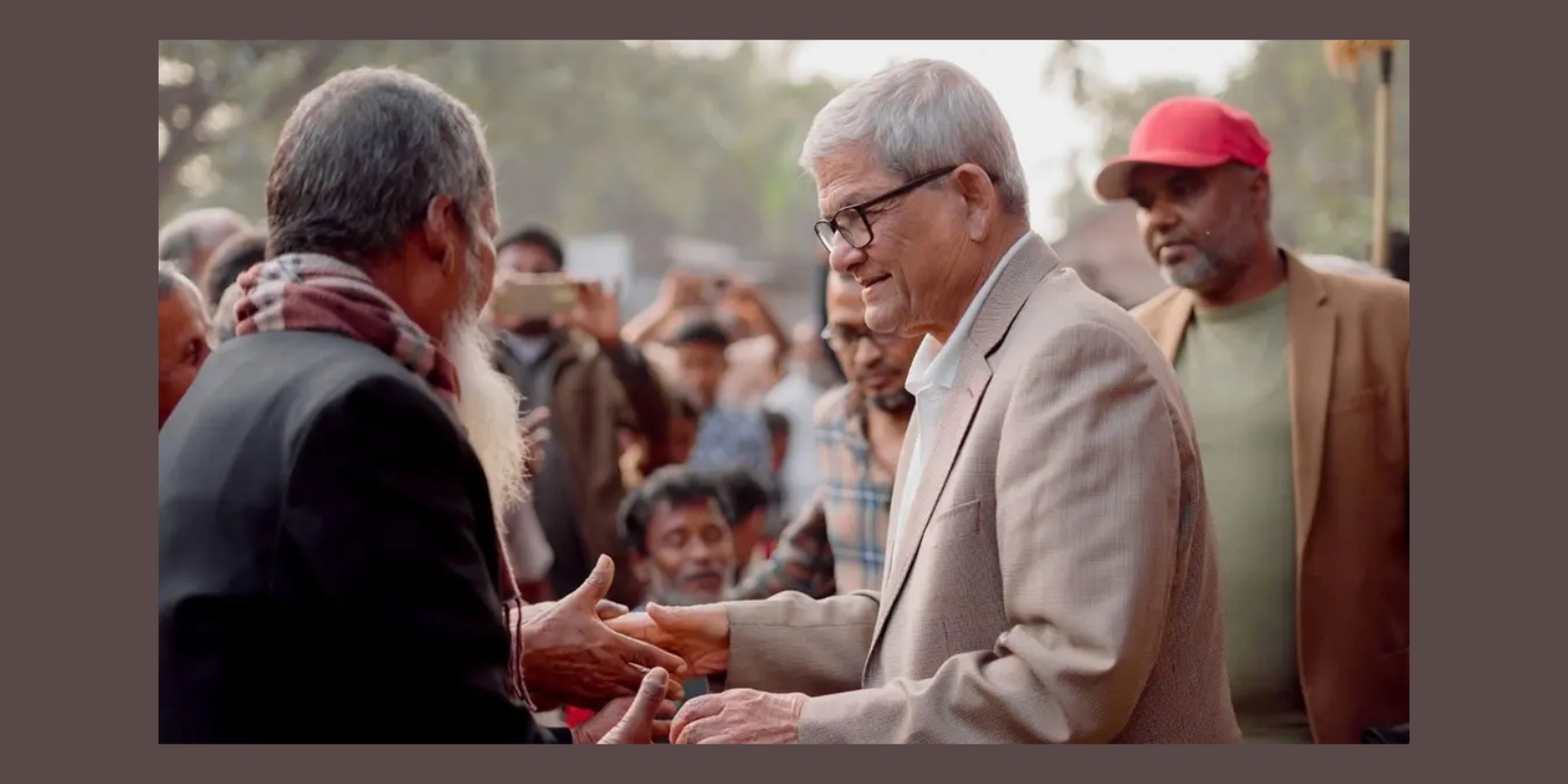
From local politics in Thakurgaon to the centre of national politics, parliament and the cabinet, Mirza Fakhrul Islam Alamgir has now reached Bangabhaban. Over the course of his long political career, he has worked as a teacher and government official, served as a municipal chairman, member of parliament and minister, and led the Bangladesh Nationalist Party (BNP) as its secretary general. The veteran politician has also endured periods of political unrest, lawsuits and imprisonment.
On Thursday (20 August), Mirza Fakhrul was elected the 23rd President of Bangladesh, securing 255 votes in the presidential election held in Parliament. His rival, Col. (retd.) Oli Ahmed, chairman of the Liberal Democratic Party (LDP) and the candidate backed by the 11-party alliance led by Jamaat-e-Islami, received 88 votes.
Mirza Fakhrul Islam Alamgir was born on 26 January 1948 in Thakurgaon. His father, Mirza Ruhul Amin, popularly known as “Chakha Mia”, was involved in politics. His uncle, Mirza Ghulam Hafiz, was also a prominent national politician and a former Speaker of Parliament. Growing up in such a political environment gave Fakhrul an early exposure to politics.
After completing his secondary education in Thakurgaon, Fakhrul moved to Dhaka. Following higher secondary studies at Dhaka College, he enrolled in the Department of Economics at the University of Dhaka. During the 1960s, he became involved in the politics of the Chhatra Union. He served as general secretary of the organisation’s SM Hall unit and later became president of Dhaka University Chhatra Union. He was also imprisoned for his political activities during the anti-Ayub movement.
After completing his university education, Fakhrul did not immediately enter full-time party politics. Instead, he began his professional career as a teacher. In 1972, he joined the Bangladesh Civil Service education cadre and started working as a lecturer in economics at Dhaka College. He later taught at several government colleges across the country, including Thakurgaon Government College.
Alongside teaching, Fakhrul was also involved in government administration. During the rule of President Ziaur Rahman, he served as secretary to then Deputy Prime Minister S. A. Bari. Various biographical accounts also mention his involvement with the Directorate of Government Inspection and Audit and several UNESCO-related activities.
In 1986, Fakhrul left government service and entered active politics. Two years later, in the 1988 municipal election, he contested independently for chairman of Thakurgaon Municipality under the bicycle symbol and won. This experience in local government provided an important foundation for his subsequent rise in national politics.
At the beginning of the 1990s, Fakhrul became actively involved in BNP politics. In 1992, he was made president of the Thakurgaon district BNP. Earlier, he had contested the Thakurgaon-1 constituency as a BNP candidate in the 1991 general election, but was defeated. He was also unsuccessful in the same constituency in the 1996 election.
Fakhrul finally entered Parliament for the first time after winning Thakurgaon-1 in the 2001 general election as a BNP candidate. When the BNP-led four-party alliance formed the government, he became State Minister for Agriculture. In November 2005, he was subsequently appointed State Minister for Civil Aviation and Tourism, a position he held until the government’s term ended in 2006.
His political role then increasingly shifted toward organisational leadership within the BNP. At the party’s fifth national council in 2009, he was elected Senior Joint Secretary General. Following the death of then Secretary General Khandaker Delwar Hossain in 2011, Fakhrul became acting secretary general. After serving in that capacity for nearly five years, he was formally elected Secretary General at the BNP’s sixth national council in March 2016.
As one of the BNP’s principal leaders during the party’s prolonged period out of power, Fakhrul led the organisation through political movements, elections, legal cases and internal organisational challenges. In the 2018 general election, he contested both Thakurgaon-1 and Bogura-6. Although he won the Bogura-6 seat, he did not take the oath as an MP in accordance with the party’s decision.
Following clashes surrounding BNP political programmes in late 2023, Fakhrul was arrested. He remained in custody during the 2024 national election. He even spent his 76th birthday in prison.
In the 2026 general election, he once again contested Thakurgaon-1 and won by a substantial margin. According to the district election office, Fakhrul received 238,836 votes, while his nearest rival, the Jamaat-e-Islami candidate, received 141,017 votes.
After the election, the BNP formed the government and Fakhrul was appointed Minister for Local Government, Rural Development and Cooperatives. He continued to serve simultaneously as the BNP’s Secretary General.
On 13 August, at a high-level party meeting chaired by BNP Chairman and Prime Minister Tarique Rahman, the party decided to nominate Fakhrul as its candidate for president. Following the nomination, he resigned from his positions as BNP Secretary General and member of the National Standing Committee. His nomination papers were subsequently submitted to the Election Commission.
After scrutiny, the Election Commission declared the candidacies of both Fakhrul and Col. (retd.) Oli Ahmed valid. In the presidential election held in Parliament on 20 August, Fakhrul won with 255 votes, while Oli Ahmed received 88.
Shortly before casting his vote, Fakhrul became emotional while speaking to journalists. He said there were many things in life that he would miss, while expressing his hope of building a happy, prosperous and welfare-oriented Bangladesh.
From teaching in classrooms to serving as a municipal chairman, member of parliament, cabinet minister and BNP Secretary General, Mirza Fakhrul Islam Alamgir has traversed a long professional and political journey. He is now set to assume the country’s highest constitutional office. He is scheduled to take the oath as President of Bangladesh on Friday evening, 21 August, formally beginning his tenure as head of state.

Design & Devlopment : Ifad Technology


