
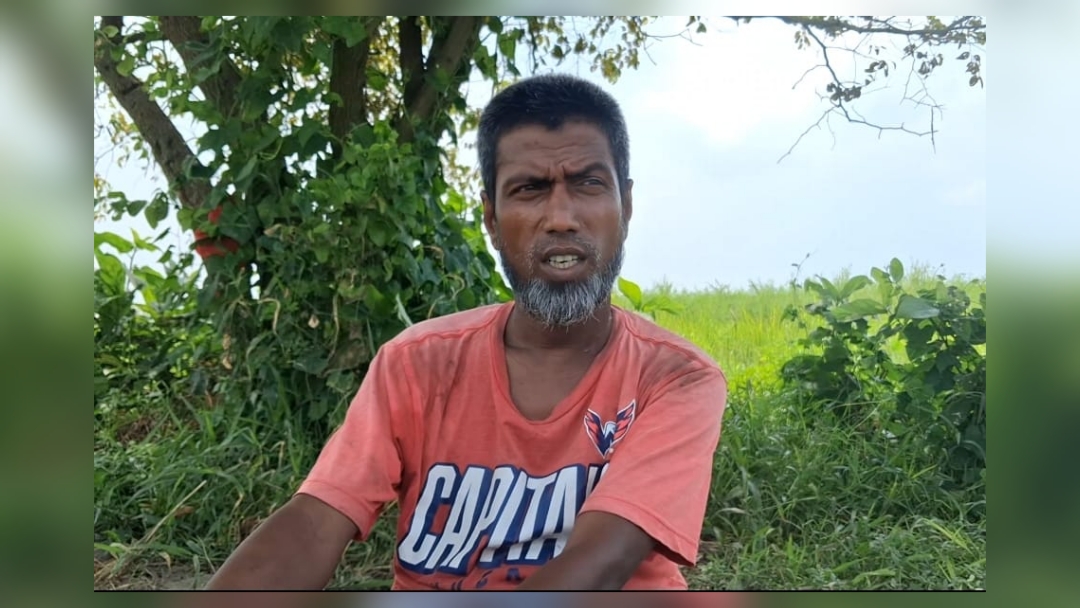
He has only a traditional Bengali house and no certainty of livelihood. When he falls ill, he cannot even afford to buy medicine beyond what he receives from government sources. His only property is a simple Bengali house. He collects jute sticks and firewood from the chars and cuts grass. That is how he supports his family.
Yet if an Aladdin’s magic lamp were to fall into his hands, he would ask for nothing for himself. Instead, he would want to stand beside the helpless people of his village.
Farmer Md Rashnai Sheikh lives in Brahmangram of Khukni Union No. 9 under Enayetpur Police Station in Sirajganj.
Recently, we met Rashnai Sheikh at Shontosa Char. Sitting alone under a large jujube tree in the middle of the vast fields, he was singing to himself. All around him were expansive char lands, cultivated fields and a quiet landscape. In that silence, the songs of Lalon Sai flowed from his voice. As we approached and began talking to him, the chapters of his life gradually began to unfold.
A significant part of Rashnai Sheikh’s life has been spent on the chars. He collects jute sticks and firewood from different parts of the char and cuts grass. These small jobs are how he spends his days and earns his living.
When asked about his assets, Rashnai Sheikh gave a very brief answer. Among his movable and immovable property, he has only one Bengali-style house. There is nothing else worth mentioning.
His circumstances are such that even when he has a fever, he cannot afford to buy medicine with his own money. Government medicine is his only source of support.
At one point in the conversation, he said, “Eating is over, betrayal has begun.” Hearing the remark, one might think he was referring to a particular incident. But after speaking with him for a while, it becomes clear that the words stem from his long experience of life.
Rashnai Sheikh’s true character, however, emerges through an imaginary question.
Suppose he were suddenly told, “You have Aladdin’s magic lamp in your hands. You can ask for anything you want—what would you ask for?”
He could have asked for a house, money or a comfortable life for himself. But his answer was different.
A man who has nothing in his life except a single Bengali-style house, no assurance of medical care, whose only reliance for medicine is government supplies, and whose livelihood depends on small jobs in the chars could have asked for many things for himself.
Instead, he said he would arrange marriages for girls in his village who cannot get married because their families lack money. He would help those who cannot afford medical treatment. He would stand beside those who cannot afford enough food.
Despite living with hardship himself, it is the hardships of others that seem to concern him more.
And what is his final wish for himself?
At the end of his life, he wants the Quran of Allah to rest on his chest. He wants to embrace the Quran and breathe his last while holding it close to his heart.
There may be no story of prosperity in the life of Rashnai Sheikh, who sings quietly across the vast fields of the char. He has no great wealth and no secure livelihood. Yet this man of limited means has made room in his thoughts for love for the poor and helpless and a desire to stand beside them.
A person’s greatness is not always measured by wealth. Sometimes, a person’s true worth is revealed by how deeply they can think about others. The life and character of Rashnai Sheikh appear to be an example of just that.
Authors:


Design & Devlopment : Ifad Technology


