
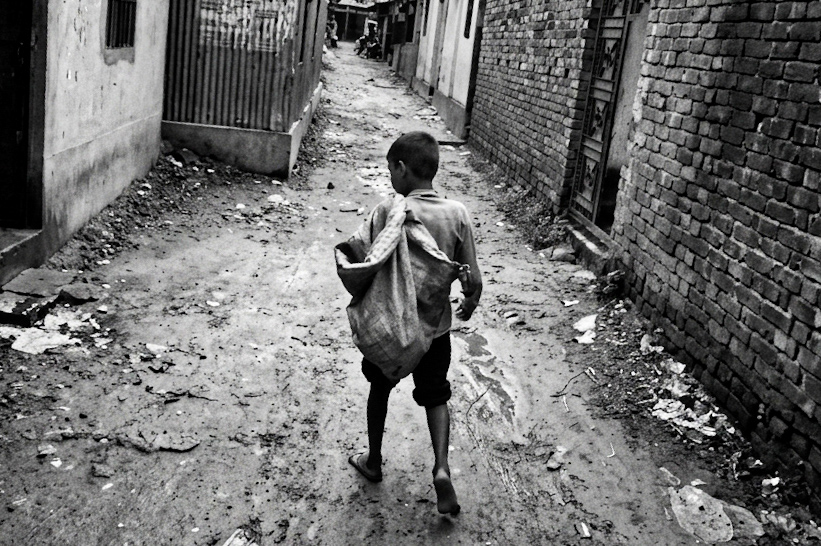
A heavy, colorful sack hangs from his back. His eyes are filled with exhaustion, and beads of sweat gather on his forehead. Eleven-year-old Rakib should have been carrying a schoolbag on his shoulders. He should have been running with his friends, books in hand, toward the playground. Instead, every morning his struggle for survival begins on the footpaths around the Airport area of the capital or amid foul-smelling piles of garbage. His three-member family survives on the money he earns by collecting discarded plastic bottles and other waste.
“I wanted to study and grow up to become a senior officer. But poor people’s wishes have no value; for the poor, even dreaming is a crime,” Rakib said. There was no sign of tears in his voice—only a profound indifference. As he gradually loses his childhood, he seems to have grown far older than his years.
Rakib lives with his younger sister and his elderly mother, who is ill. Buying his mother’s regular medication and putting a handful of rice on his little sister’s plate all depend on the bottles Rakib collects each day. Crowded sidewalks or piles of garbage beside dumpsters—wherever discarded items accumulate becomes Rakib’s workplace. What others see as worthless waste is, to Rakib, a small source of hope for buying his mother’s medicine.
He once dreamed of going to school, but hunger and the harsh realities of life have pushed him onto the streets. “Children like us live on the streets and collect bottles. But hunger doesn’t let us study. It is hunger that has forced us onto the streets,” Rakib said. His simple yet piercing words raise a question about the social reality of the country.
According to recent data from the United Nations Children’s Fund (UNICEF), more than 3.4 million street-connected children in Bangladesh are growing up in vulnerable conditions. Rakib is merely one tragic face among that vast number. Millions of children like him are growing up deprived of their basic rights.
Who is responsible for the situation of children who wander the streets because they lack security and lose their way while trying to satisfy hunger instead of receiving an education? When a child grows up and becomes involved in a crime, the blame is easily placed on the child. But can the structural failures of a state and society that failed to provide that child with a safe and healthy childhood truly be ignored?
The value of a child’s childhood cannot be measured in monetary terms. To restore the lost childhoods of children like Rakib, it is essential to strengthen social safety nets, ensure access to free healthcare and education, and undertake coordinated rehabilitation initiatives. Because when a child’s dreams are disappearing amid piles of garbage today, protecting that child’s future is a responsibility shared by both society and the state.


Design & Devlopment : Ifad Technology


